
Revocable vs Irrevocable Trust
Revocable and irrevocable trusts can both be useful, but they solve different problems. A revocable trust usually emphasizes control and management convenience, while an irrevocable trust is often used when stronger separation, tax planning, or long-term protection is the goal.
Trust-focused planning
Clear structure for asset protection, long-term stewardship, and family control.
Step-by-step guidance
Planning, drafting, funding, and next-step clarity in one coordinated process.
Designed for real-world use
Built to be understandable, actionable, and easier to maintain over time.
The core difference in one sentence
A revocable trust can usually be changed or undone by the person who created it, while an irrevocable trust generally requires the grantor to give up more control in exchange for different planning benefits. That difference affects management, tax treatment, creditor protection, and how the trust fits into long-term wealth planning.
How the two structures compare
| Issue | Revocable trust | Irrevocable trust |
|---|---|---|
| Control | Grantor usually keeps broad control | Grantor usually gives up more control |
| Flexibility | High during the grantor’s life | Lower, although terms can vary and some flexibility can be built in |
| Primary use | Management convenience, continuity, probate avoidance | Protection, tax planning, Medicaid planning, long-term stewardship |
| Creditor separation | Usually limited because the grantor still controls the assets | Often stronger when the design and administration support real separation |
When a revocable trust tends to fit
Management convenience
A revocable trust can make it easier to manage assets, deal with incapacity concerns, and avoid probate-style delays.
Simple family continuity
Families who want a flexible structure for ordinary estate planning often start here.
High-control planning
People who are not ready to part with control may prefer a revocable structure while they clarify longer-term goals.
That said, a revocable trust is usually not the structure people choose when the central goal is stronger creditor resistance.
When an irrevocable trust becomes more relevant
Asset protection planning
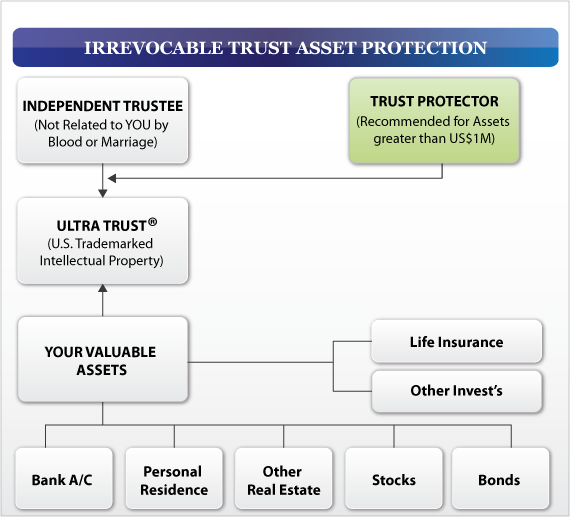
An asset protection trust usually requires a more meaningful ownership shift than a revocable trust provides.
Medicaid or long-term care planning
Some families explore Medicaid irrevocable trust planning when future care costs become part of the conversation.
Tax and transfer strategy
Irrevocable structures are also used when gift, estate, or specialized transfer goals matter more than day-to-day control.
What people often get wrong in the comparison
- Assuming revocable and irrevocable trusts are interchangeable
- Focusing only on flexibility and ignoring the planning objective
- Believing every irrevocable trust does the same job
- Overlooking trustee design, funding, and beneficiary language
- Choosing based on comfort alone instead of the actual risk and goal
The better question is not “which trust is better?” It is “which trust is better for the result I actually need?”
The right trust depends on the purpose
If control and management convenience are the priority, a revocable trust may fit beautifully. If protection, long-term separation, or specialized planning is more important, an irrevocable structure may be the more appropriate path. The trust should be chosen for the job it needs to do, not because the label sounds familiar.
Need help choosing between them?
A planning review can help connect the trust type to your real objective instead of a generic assumption.
Frequently asked questions
Can a revocable trust protect assets from creditors?
Usually not in the same way an irrevocable structure may, because the grantor generally keeps broad control over the assets.
Can an irrevocable trust ever be changed?
Sometimes limited flexibility can be built into the design, but an irrevocable trust is generally less flexible than a revocable one.
Which trust is better for ordinary estate planning?
A revocable trust is often used for management convenience and continuity, but the right answer depends on the familyu2019s goals.
Which trust is more relevant for protection planning?
Irrevocable structures are more commonly discussed when meaningful separation or advanced protection is the objective.
Ready to take the next step?
Get clear guidance on trust structure, planning priorities, and the next move that fits your assets and goals.