

In today’s climate, securing your wealth is more important than ever. One of the best ways to protect your assets is with trust protection. Trust Protection is the term for the use of legal strategies to protect your wealth from creditors, lawsuits, and other risks. It is particularly important for people with considerable assets or those who want to make sure their property is handed down safely to their heirs. The wealth protection trust can be the key to secure your wealth whether you are a business owner, a high-net-worth individual or need to secure your family. In this article, we’re going to look at what trust protection is, why it’s important, and how you can have it in your estate planning.
What is Trust Protection?
Trust protection is a system of asset protection that involves certain strategies to make the assets in a trust more difficult for creditors and others to reach. When you put your assets in a trust, you no longer personally own them. Rather, a Selecting a Trustee manages your assets for the benefit of your beneficiaries. By protecting your assets with a trust, you can ensure they remain excluded from outside claims – so that both you and your loved one’s stay worry-free.
Why is Trust Protection Important?
Trust protection is important because it helps to keep your wealth in the family and ensure you’re not vulnerable to a lawsuit or creditor claiming your assets. Assets held in trust may be at risk without proper asset protection strategies in place. There are different ways through which you can protect your wealth like irrevocable trusts or offshore trusts.
| Type of Trust | Protection Level | Purpose |
| Revocable Trust | Low | Flexible: Can be modified or revoked at any time; primarily used for probate avoidance. |
| Irrevocable Trust | High | Permanent: Cannot be modified easily; removes assets from your personal estate to offer strong protection. |
| Offshore Trust | Very High | Jurisdictional Shield: Provides protection against domestic legal claims by moving assets to foreign jurisdictions. |
| Spendthrift Trust | Moderate to High | Beneficiary Control: Protects assets from the creditors of the beneficiaries by limiting their access to the principal. |
There are several strategies and tools available to help protect assets placed in a trust. Let’s delve into some of the most common and effective methods.
1. Irrevocable Trusts
Once created, an irrevocable trust stays in place and cannot be changed. When you place your assets in an irrevocable trust, you take ownership off of yourself. An irrevocable trust protects its assets from creditors and other third parties. A spendthrift trust offers the most protection, restricting others from accessing the trust and ensuring that no lawsuits can attach liens to the assets.
2. Offshore Trusts
Offshore trusts are formed in foreign jurisdictions with favorable and protective laws. Those jurisdictions often lend themselves to easier access to bankers’ markets in the event of default. When you put your assets in an offshore trust, you safeguard them in another country. Which can help if someone tries to sue you or if you run into financial trouble in your own country. Nevertheless, offshore trusts require legal planning and knowledge of international laws to comply properly.
3. Spendthrift Trusts
A spendthrift trust protects a beneficiary’s assets when the beneficiary struggles to manage money. This type of trust prevents creditors from accessing trust assets and helps safeguard both the individual’s wealth and estate. Creators often establish spendthrift trusts when they have concerns about a beneficiary’s financial habits.
4. Domestic Asset Protection Trusts (DAPTs)
DAPTs are trusts set up in the United States under state law. Although not as protective as offshore trusts, don’t underestimate the usefulness of domestic asset protection trusts in deterring creditor claims and lawsuits. High-net-worth individuals who want to protect their assets without worrying about the complexities of international law will find DAPTs to be a good option.
Comparison of Trust Protection Methods
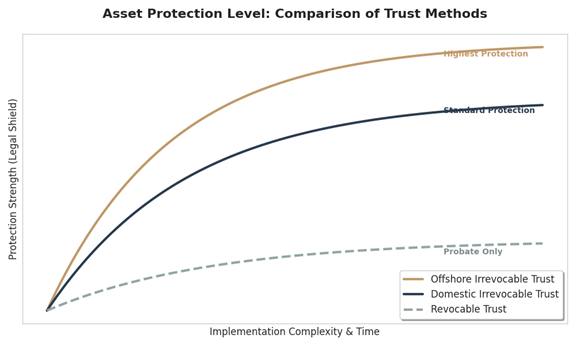
- The Control-Protection Trade-off: The “Revocable Trust” line still stays at the very bottom of the chart because the grantor retains the right to terminate it. In simple terms, the “High Flexibility” of a revocable trust is at the same time its weakness in protection, thus the assets remain exposed to personal claims.
- The Impact of Jurisdictional Barriers: There is a considerable vertical distance between “Offshore” and “Domestic” trusts on the line chart which clearly demonstrates the power of jurisdictional separation. Offshore trusts obtain a more elevated protection level as they require creditors to sue in foreign courts, thus presenting a much stronger legal barrier.
- Permanence as a Lever: The “Irrevocable” quarterly (both Domestic and Offshore) indicate that the protection levels can only be attained through the “High Discipline” of giving up ownership. By an irreversible division of the individual from the asset, these trusts result in a “Secure Fit” which is resilient even under severe legal attack.
- Probate vs. Asset Protection: The dotted line for the Revocable Trust indicates that its potential is mostly restricted to “Basic Setup” tasks such as probate avoidance. No matter how long the trust is in existence. It does not turn into a strong defense mechanism.
- Complexity Correlates with Security: The shift from the dashed gray line to the solid gold line demonstrates that increased levels of protection entail “Professional Development” (intricate planning and multi, layered legal strategies). This is in line with the earlier comparisons where luxury arrangements provide the highest potential for sustainability and growth.
Practical Tips for Implementing Trust Protection
Consult with a Trust Attorney: It is always best to work with a seasoned estate planning and asset protection attorney.
Choose the Right Type of Trust: Your decision of a trust will depend on your requirements and the degree of protection you want. For maximum security, an irrevocable trust is what you need. However, if you want flexibility, revocable trusts are the way to go.
Review and Update Your Trust Regularly: Whenever there are changes in your finances, you should also adjust your trust protection plan accordingly. Continuous reviewing of your trust will keep it aligned with your needs.
Consider Combining Trusts: Sometimes, a combination of trusts like a revocable trust teamed with an irrevocable component can give you both flexibility and protection.
Trust protector is one of the significant ways to secure your wealth and ensure that your assets can be passed on to your children without any trouble with Ultra Trust. In, depth knowledge of various trust types and protective tactics will help you decide the most efficient way of wealth protection. One can go for an irrevocable trust, offshore trust, or a spendthrift trust. Anyway the important thing is to partner with a knowledgeable lawyer who will guide you. In choosing and implementing the right solution for your specific situation.
Where the next decision becomes clearer
Once The Importance of Trust Protection: Safeguard Your Assets is on the table, the next questions usually center on risk, flexibility, and which planning step deserves attention first.
Points readers weigh before moving forward
- Timing matters because planning choices usually become narrower once a problem is already close.
- Control matters because the answer often depends on how much access or authority the owner wants to keep.
- Funding matters because a trust or entity has to be set up and maintained correctly to matter.
Practical reading path
To keep the next step practical rather than abstract, readers often move to Asset Protection Trust, Irrevocable Trust, and How It Works. When the question turns from reading to implementation, many readers move from these guides to a direct planning conversation.