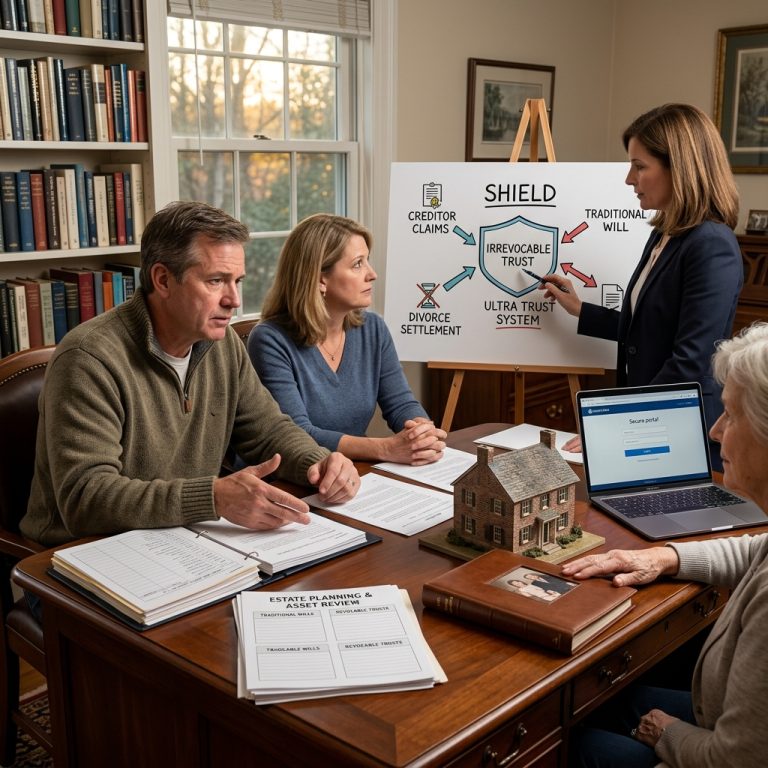
The Problem: Uncertainty About Your Trust’s Future After You’re Gone
Last Updated: January 2026
When you establish an irrevocable trust as part of your wealth protection strategy, you’re securing your assets during your lifetime. But what happens after you pass? This is where many high-net-worth individuals encounter confusion—and where the real power of irrevocable trusts reveals itself. An irrevocable trust doesn’t simply disappear when the grantor dies. Instead, it continues to operate under the direction of a successor trustee, distributing assets to beneficiaries according to your written instructions, maintaining tax efficiency, and preserving the creditor protection you’ve established. The trust document itself becomes the governing instrument for years or even decades after your death, ensuring your wealth transfers privately, avoids probate, and remains shielded from claims against your estate. Understanding how this process unfolds helps you design a trust structure that actually works for your heirs.
Key Takeaways:
- Irrevocable trusts continue operating after the grantor’s death under a successor trustee’s management
- Beneficiary distributions, tax filings, and asset management all proceed according to the trust document
- Creditor protection benefits transfer to your beneficiaries, protecting inherited assets
- IRS compliance and ongoing trust administration require qualified independent trustees
- Our Ultra Trust® system provides clear succession guidelines and court-tested asset protection frameworks
Most wealthy individuals understand that an irrevocable trust protects their assets during their lifetime. What they often don’t know is what happens to that trust machinery after they die—and whether it will actually protect their heirs the way they intended.
This gap in planning creates real problems. Without clear succession guidelines, heirs may inherit assets only to see them vulnerable to creditors, ex-spouses, or bad decisions. The trust document may sit dormant without proper administration, missing IRS filing deadlines. Worse, ambiguous instructions about distributions can trigger family disputes and costly trust litigation—the exact opposite of the legacy you wanted to leave.
The uncertainty comes from the fact that irrevocable trusts operate differently than most people expect. Unlike a revocable trust that dissolves when you die, an irrevocable trust persists as a separate legal entity. Your successor trustee becomes the fiduciary in control, but without clear guidance, they may struggle with interpretation, tax planning, and distribution decisions. This is where professional-grade trust design makes all the difference.
FAQ: What happens to an irrevocable trust when the grantor dies?
An irrevocable trust does not dissolve or terminate when the grantor dies—it continues as a separate legal entity under the direction of the successor trustee named in the trust document. The successor trustee assumes full fiduciary responsibility for managing, investing, and ultimately distributing the trust assets according to the grantor’s written instructions. The trust remains in place to serve its original purpose: protecting assets from creditors, managing taxes, and ensuring that distributions flow to beneficiaries as intended. At Estate Street Partners, we design Ultra Trust® structures with exceptionally detailed successor trustee guidelines so the transition is seamless and the protection you built continues uninterrupted for your heirs.
FAQ: Why do some people think their irrevocable trust ends when they die?
This misconception often stems from confusion with revocable trusts, which can be dissolved by the grantor during their lifetime and automatically terminate at death. Irrevocable trusts, by contrast, are designed to outlive the grantor precisely because they cannot be modified or dissolved by the grantor unilaterally. Additionally, many people conflate the irrevocable trust with the probate process—imagining that once someone dies, everything gets tied up in court. An irrevocable trust actually bypasses probate entirely, meaning its assets transfer immediately to the successor trustee without court involvement or public disclosure. This private, streamlined continuation is one of the core benefits families discover after the grantor’s death.
How Irrevocable Trusts Continue Beyond the Grantor’s Lifetime
The legal framework is straightforward: an irrevocable trust is a separate legal entity with its own taxpayer identification number (EIN) and its own existence independent of you. When you die, the trust doesn’t die with you. Instead, it enters a post-mortem phase where it continues to hold, manage, and eventually distribute your assets.
This continuation serves several critical functions:
- Asset protection persists: The creditor shielding you built into the trust structure remains in place for your beneficiaries. A creditor of your estate cannot reach assets already inside the irrevocable trust.
- Privacy is maintained: Trust assets never enter probate, so no public court filings reveal your wealth, beneficiaries, or distribution instructions.
- Tax efficiency continues: The trust’s tax structure doesn’t reset at death—it carries forward according to the terms you established, often deferring or minimizing taxes owed by beneficiaries.
- Distributions follow your plan: Assets don’t get divvied up by a judge or by default state law. Your successor trustee distributes according to your explicit instructions.
The transition happens automatically. Your successor trustee steps into the role you’ve already named in the trust document. No court approval is needed. The moment your death is confirmed and documented, the successor trustee becomes the legal fiduciary responsible for the trust’s operation.
One practical detail many families overlook: you should name an independent successor trustee—someone without a personal stake in the distribution outcome. This independence protects the trust’s integrity and its ability to defend itself legally if a beneficiary or creditor later challenges distributions. Some families choose a corporate trustee or a combination of an individual and a corporate co-trustee for this reason.
FAQ: How long does an irrevocable trust last after the grantor dies?
An irrevocable trust can continue for decades after the grantor’s death, depending on how it was drafted. Some trusts are designed to distribute all remaining assets within a few years of the grantor’s death, terminating once distributions are complete. Others are structured to continue indefinitely, providing ongoing protection and management for multiple generations. Dynasty trusts, for example, are specifically designed to benefit multiple generations and can operate for 100+ years in many states. The duration depends entirely on the trust document’s terms—which is why it’s critical to clarify your intentions during the drafting process. At Estate Street Partners, we design trusts with explicit duration terms so both the successor trustee and your beneficiaries understand exactly how long the trust will operate and when it will ultimately terminate.
FAQ: Does the successor trustee have to follow the grantor’s original wishes, or can they make changes after death?
The successor trustee is legally bound by the trust document and cannot unilaterally change the grantor’s core instructions. They are a fiduciary, meaning they have a legal duty to manage and distribute assets according to the terms you set out. However, the trust document should include some built-in flexibility—such as discretionary distribution language—that allows the trustee to make reasonable decisions within the framework you’ve established. For example, if your trust says “distribute to beneficiaries as needed for health, education, and living expenses,” the trustee has some discretion about timing and amounts, but cannot simply give everything to one beneficiary if you specified equal distribution. Estate Street Partners drafts succession language that balances trustee flexibility with your core intent, preventing future disputes while allowing the trustee to adapt to real-world circumstances.
The Successor Trustee’s Critical Role in Trust Administration

After your death, your successor trustee becomes the most important person in your trust’s operation. This role is far more demanding than many people realize, and it directly affects whether your heirs receive their inheritance smoothly and whether the tax benefits you built into the trust actually materialize.
The successor trustee’s responsibilities include:
- Securing and inventorying assets: Locating all trust property, securing valuables, and creating a detailed list of what the trust holds.
- Filing IRS forms and trust tax returns: Obtaining an EIN if the trust doesn’t already have one, filing Form 1041 (trust income tax return) each year the trust operates, and ensuring all beneficiaries receive appropriate K-1 statements.
- Managing ongoing investments: Making prudent investment decisions, rebalancing portfolios, and ensuring assets grow according to your risk profile.
- Handling creditor claims: Properly managing and evaluating any claims against the estate or trust (this is where irrevocable trust protection shines—many claims are rejected outright).
- Making distributions: Calculating when and how much to distribute to each beneficiary based on your written instructions.
- Maintaining trust records: Keeping meticulous documentation of all transactions, distributions, and decisions.
This is administrative work that spans months or years. Many families find that naming a successor trustee without clear guidance creates friction—the trustee feels uncertain about their authority, beneficiaries question decisions, and simple tasks become complicated.
The solution is a detailed trust document with clear successor trustee guidelines. We design Ultra Trust® structures that include explicit instructions about investment philosophy, distribution timing, communication protocols, and decision-making authority. This clarity protects both the trustee and the beneficiaries.
FAQ: Can a beneficiary also be the successor trustee?
Yes, a beneficiary can serve as successor trustee, but it creates potential conflicts of interest. If your daughter is both trustee and a primary beneficiary, the other beneficiaries may question whether her decisions prioritize her own inheritance over fair treatment of everyone. For this reason, many families use a co-trustee structure: a family member paired with an independent trustee (such as a bank or trust company). This arrangement allows for family involvement while protecting trust integrity. Alternatively, some families name a professional independent trustee from the start. The key is recognizing that creditor protection and family harmony often benefit from clear structural separation between trustee authority and beneficiary interest. At Estate Street Partners, we help families determine the right trustee structure based on their asset level, family dynamics, and protection goals.
FAQ: What happens if the successor trustee makes a mistake or acts improperly?
A trustee who breaches their fiduciary duties—by mismanaging assets, making self-serving distributions, or failing to follow the trust document—can be removed by beneficiaries through a trust removal action. The beneficiaries can petition a court to replace the trustee and potentially recover damages for losses caused by the breach. This is why the trustee role is serious and why many people prefer naming a corporate trustee or an independent third party rather than a family member without business or financial experience. Proper trustee education and clear documentation also help prevent unintentional mistakes. Some of our Ultra Trust® clients include detailed trustee guidance documents and even video instructions to help their successor trustees understand complex assets or unusual distribution provisions.
Asset Distribution and Beneficiary Payments After Death
Once your successor trustee is in place and the trust’s assets are accounted for, the next phase is distribution. This is where your beneficiaries finally receive the inheritance you intended for them.
The timing and structure of distributions depend entirely on how you drafted your trust. You have several options:
- Immediate lump-sum distribution: The trustee distributes the entire trust balance to beneficiaries shortly after your death, and the trust terminates.
- Installment distributions: The trustee makes payments over time (e.g., a portion each year for 5 or 10 years), providing ongoing management and creditor protection.
- Discretionary distributions: The trustee retains discretion to distribute funds “as needed” for beneficiaries’ health, education, maintenance, and support, allowing flexibility based on real circumstances.
- Conduit trust: Beneficiary receives all distributions (including required minimum distributions if inherited funds are from an IRA or retirement account) in the year received—useful for income tax planning.
- Accumulation trust: Trustee can accumulate income and distribute principal at their discretion, offering more control and potentially better tax outcomes.
The distribution structure you choose directly impacts your beneficiaries’ financial security. A young beneficiary who receives a $500K lump sum may squander it or face creditor claims. That same beneficiary protected by a longer-term discretionary trust—where the trustee makes distributions as needed—keeps the assets protected and managed.
This is also where irrevocable trust creditor protection truly matters. Once your death occurs and distributions are made to beneficiaries, those inherited assets remain protected from the beneficiary’s future creditors (depending on your trust’s specific language and state law). If you had simply left assets outright in your will, your heirs would inherit them exposed to lawsuits, bankruptcy, or creditor claims.
FAQ: Can a beneficiary receive distributions before the grantor dies?
Yes, depending on how the trust is drafted. Some irrevocable trusts allow for distributions to beneficiaries during the grantor’s lifetime—for example, distributing income to a spouse or major distributions to children at specified ages or milestones. This flexibility actually enhances asset protection because you can benefit your family while the assets are still sheltered inside the trust structure. Other trusts are designed to distribute nothing until the grantor’s death, preserving the full asset base. The key is that all distributions—whether during life or after death—must align with the trust document’s terms and the trustee’s fiduciary duty. At Estate Street Partners, we design flexible ultra-trusts that allow for meaningful distributions during your lifetime while maintaining ironclad protection for the assets that pass to your heirs.
FAQ: What if a beneficiary needs money before their scheduled distribution?
A well-drafted irrevocable trust includes discretionary language that allows the successor trustee to make unscheduled distributions if circumstances warrant—medical emergencies, job loss, education expenses, or genuine hardship. The trustee is not required to make these extra distributions, but having the authority to do so adds practical value. Without this flexibility, a beneficiary facing a real emergency would have no recourse if the trust’s written schedule doesn’t align with their need. Of course, the trustee must document these discretionary decisions carefully and ensure they’re not simply giving away trust assets arbitrarily. The balance between flexibility and structure is where good trust drafting shows its value.
Tax Implications and IRS Compliance for Ongoing Trusts
After the grantor’s death, the irrevocable trust becomes a taxpaying entity in its own right. The IRS doesn’t stop tracking it—in fact, tax compliance becomes more complex, not simpler.
Here’s what happens at the tax level:
The trust receives its own EIN (or continues with the one assigned at creation). This separates the trust’s tax life from your personal estate.

Form 1041 must be filed annually. The trust’s income (dividends, interest, capital gains, rental income) is reported on Form 1041, and beneficiaries receive K-1 statements showing their share of trust income. This continues every year the trust remains in existence and holds assets.
Income can be taxed at the trust level or distributed to beneficiaries. The trust document controls this. If the trustee distributes all income to beneficiaries, they report it on their individual returns (often at lower tax rates). If the trust retains income, it’s taxed at the trust’s rate, which is notably less favorable (the top federal rate kicks in at much lower income levels for trusts than for individuals).
Estate tax and generation-skipping tax may apply depending on the trust’s size and structure. If your irrevocable trust is still holding assets valued above the federal exemption threshold when you die, those assets may be subject to federal estate tax. However, properly structured irrevocable trusts are designed to fall outside your taxable estate entirely—which is one of the primary reasons high-net-worth individuals use them.
Beneficiary distributions have tax consequences. If a beneficiary receives a distribution of trust income, they owe income tax on it. If they receive a distribution of principal (non-income assets), generally no income tax applies. The trustee must properly characterize each distribution to ensure beneficiaries report correctly.
The complexity here is significant. A successor trustee without tax expertise can make costly mistakes—missing deadlines, misclassifying distributions, or failing to optimize income splitting between the trust and beneficiaries. This is why we often recommend that clients engage a tax advisor to work alongside the successor trustee, especially in the first few years after death when the trust’s tax structure is most critical.
FAQ: Does an irrevocable trust save income taxes after the grantor dies?
An irrevocable trust doesn’t automatically save income taxes simply by continuing after the grantor’s death. However, it can enable significant income tax planning if the trustee makes wise distribution decisions. For example, if the trustee distributes income to beneficiaries in lower tax brackets, that income is taxed at their lower rates rather than at the punitive rates trusts pay. Additionally, some irrevocable trusts are structured with specific income-shifting provisions that defer or minimize taxes for multiple years. A Charitable Remainder Trust, for instance, can distribute income to beneficiaries tax-efficiently while ultimately benefiting charity. The key is that tax optimization requires active trustee decision-making and proper accounting—which is why professional trust administration pays for itself through tax savings alone. Our Ultra Trust® clients receive detailed tax guidance for their successor trustees to ensure post-death tax planning is done correctly.
FAQ: What IRS forms and deadlines apply after the grantor dies?
The primary IRS compliance deadline is the annual Form 1041 filing deadline (typically April 15th in the year following the close of the trust’s tax year, though an extension to October 15th is available). Additionally, if the trust distributed any capital gains, the trustee must report those on Form 8949 and Schedule D. If a beneficiary received more than $600 in reportable income, they must receive a completed Schedule K-1. Failure to file these forms can trigger penalties and IRS scrutiny. For trusts with significant assets or complex income, a quarterly estimated tax payment may be required. At Estate Street Partners, we emphasize that successor trustees should coordinate with a CPA or tax attorney familiar with trust taxation—the rules are specific and non-compliance is costly.
Creditor Protection Remains Intact for Your Beneficiaries
One of the most powerful features of an irrevocable trust becomes fully apparent after your death: the creditor protection you built doesn’t vanish. Instead, it transfers to your beneficiaries.
Here’s the critical distinction: assets held in a properly structured irrevocable trust are not part of your taxable estate, and they are not accessible to your creditors. When you die and your beneficiaries inherit those assets through the trust, those assets remain protected from the beneficiaries’ creditors as well.
This matters enormously. Consider a real scenario: you pass away and leave $2 million to your daughter through an irrevocable trust. Two years later, your daughter is sued in a car accident lawsuit and a judgment is entered against her for $500K. If the $2 million had simply been left to her outright through your will, the judgment creditor could seize and liquidate those inherited assets to satisfy the judgment. But because the $2 million is held in a protected irrevocable trust, the creditor cannot touch it. The trust’s protective structure shields the inheritance from her personal liability.
This protection is why irrevocable trusts vs revocable trusts distinction matters so profoundly. A revocable trust offers privacy (avoiding probate) but no creditor protection. An irrevocable trust offers both privacy and genuine legal liability protection—for you during your lifetime and for your heirs after you’re gone.
The protection is strongest when the trust document includes spendthrift language, which prohibits beneficiaries from transferring their interests to third parties and prevents creditors from attaching the trust assets directly. Modern irrevocable trusts virtually always include spendthrift provisions, which is standard in our Ultra Trust® system.
There are limits. The creditor protection applies to the trust itself, not to distributions already made to beneficiaries. Once the trustee distributes cash or assets to a beneficiary, that distributed property is no longer inside the trust—it’s the beneficiary’s personal property and is subject to their creditors. This is why discretionary distribution language is valuable: the trustee can manage the timing and amount of distributions strategically, ensuring that only what’s needed is distributed and the bulk remains protected inside the trust.
FAQ: What if a beneficiary wants to opt out of the irrevocable trust and receive their inheritance outright?
Generally, no. A beneficiary cannot unilaterally “break out” of an irrevocable trust and demand distributions on their own schedule—the trustee controls distributions according to the trust document. However, beneficiaries do have the right to request that the trustee make a distribution, and a trustee may have discretion to make distributions. Additionally, in some states, beneficiaries can petition a court to modify or terminate a trust under specific circumstances (such as changed circumstances that make the trust’s purpose impossible). But these are exceptions. The default rule is that beneficiaries are bound by the trust’s terms. This is actually protective—if your beneficiary faces creditors and asks the trustee to “distribute everything so I can pay my debts,” the trustee can refuse, preserving the protection you built. At Estate Street Partners, we emphasize to clients that the irrevocable nature of the trust—meaning it cannot be changed even by beneficiaries—is a feature, not a limitation.
FAQ: Does creditor protection apply if a beneficiary is sued after the grantor dies?
Yes, fully. The creditor protection features of an irrevocable trust apply to claims against beneficiaries after the grantor’s death, provided the trust was properly structured with spendthrift language and the distribution was made according to the trust document. This is one of the most powerful post-mortem benefits: your beneficiaries inherit not just assets, but assets that are legally shielded from their personal creditors, bankruptcy trustees, or ex-spouses’ claims. This protection can endure for their entire lifetimes or for multiple generations, depending on how long the trust is drafted to continue. It’s the difference between leaving $1 million fully exposed to your child’s future creditors versus leaving $1 million in a protected structure that preserves the wealth regardless of your child’s personal circumstances.
Our Ultra Trust System Ensures Seamless Succession Planning
At Estate Street Partners, we’ve refined irrevocable trust design specifically to address the challenges families face after the grantor’s death. Our Ultra Trust® system integrates succession planning, tax optimization, creditor protection, and beneficiary communication into a single cohesive framework.

Here’s how our approach differs:
Court-tested asset protection language: Our trust documents are drafted with provisions that have survived litigation. We don’t rely on generic templates—every Ultra Trust® incorporates language tested in actual court cases, ensuring that the protection you build holds up if creditors or beneficiaries later challenge the trust.
Detailed successor trustee guidelines: Rather than leaving the successor trustee to guess at your intentions, we include explicit written guidance on investment philosophy, distribution principles, communication expectations, and decision-making authority. This clarity prevents disputes and ensures your legacy operates as you intended.
Tax-efficient distribution architecture: We design trusts with multiple distribution pathways—allowing the trustee to optimize taxes while still meeting your family’s needs. This might include discretionary distributions to lower-income beneficiaries, income retention at the trust level when beneficial, or strategic use of conduit versus accumulation language.
Beneficiary communication protocol: Many families face confusion when the grantor dies because heirs don’t understand how the trust works. We provide frameworks for the trustee to educate beneficiaries about their rights, the trustee’s duties, and the trust’s ongoing operation.
Ongoing compliance support: We can coordinate with your successor trustee and CPA to ensure annual Form 1041 filings, tax reporting, and IRS compliance happen on schedule.
Multi-generational design: If your goal is to benefit not just your children but grandchildren and beyond, we structure the trust to support that longevity while maintaining maximum creditor protection across generations.
The Ultra Trust® system is built on the principle that irrevocable trusts should work seamlessly from day one through generations. We design them to be understood by your heirs, administrable by your successor trustee, compliant with the IRS, and protective when creditors challenge.
FAQ: How does Ultra Trust® differ from a standard irrevocable trust?
Ultra Trust® is our proprietary system that integrates irrevocable trust design with comprehensive asset protection, tax planning, and succession administration. Unlike a standard irrevocable trust—which may be drafted generically by an attorney unfamiliar with asset protection strategies—every Ultra Trust® is built on court-tested protective language, detailed successor trustee guidelines, and explicit tax optimization provisions. We also provide ongoing support to ensure the trust operates correctly after your death, including coordination with your trustee and tax professionals. This comprehensive approach means that the protection you build actually persists and functions as intended, rather than remaining merely theoretical.
FAQ: Can I change an Ultra Trust® after it’s established?
No, and this is by design. An irrevocable trust cannot be changed by the grantor after creation—that irrevocability is what creates the asset protection and tax benefits. However, this also means you should be certain about your decisions before signing. At Estate Street Partners, we spend substantial time with clients in the planning phase to ensure the trust structure aligns with your family situation, goals, and values. We also allow flexibility within the document itself—such as trustee discretion on distributions, investment decisions, and the ability to modify trust administration procedures in limited ways. If circumstances change dramatically after the trust is created, there are court procedures to modify trusts in some states, though these should be rare if planning was done well.
Why Choose Estate Street Partners for Your Irrevocable Trust Planning
Irrevocable trusts are powerful tools, but they’re only as good as the document that creates them and the guidance given to the successor trustee. Many high-net-worth individuals work with attorneys who understand wills and probate but lack expertise in asset protection and the nuances of irrevocable trust administration.
We specialize in exactly what happens after the trust is signed. Our focus is on:
Creditor protection that holds up in court: We design trusts with protective language that has been tested against actual creditor claims. We study case outcomes to ensure that the features we build into your trust will survive if someone later tries to pierce it.
Successor trustee clarity: We don’t hand you a trust document and hope for the best. We work with you to identify the right successor trustee, we draft their guidelines clearly, and we often provide transition training so they understand the trust’s operation and their role.
Tax optimization: We coordinate with your CPA or tax attorney to ensure the trust’s tax structure works in concert with your overall financial plan. This includes income distribution strategies, beneficiary tax positioning, and compliance with IRS requirements.
Family communication: We help you document your wishes not just legally, but in a way your heirs will understand. This reduces post-death disputes and ensures the inheritance process runs smoothly.
Ongoing support: Our relationship doesn’t end when the trust is signed. We’re available to advise your successor trustee, coordinate with tax professionals, and ensure the trust operates correctly through its entire lifecycle.
We work exclusively with high-net-worth individuals and families because the stakes are high and the complexity is real. A mistake in irrevocable trust design or administration can cost your heirs hundreds of thousands of dollars—or worse, leave them vulnerable to creditors despite your intention to protect them.
Ready to ensure your irrevocable trust will work flawlessly after you’re gone? We recommend scheduling a detailed consultation to review your current trust structure (if you have one) or to design a court-tested Ultra Trust® system tailored to your wealth, family, and protection goals. Contact us to explore certified irrevocable trust planning that actually delivers the protection and family harmony you’re seeking.
Contact us today for a free consultation!