
Money doesn’t just sit around; it either grows, shrinks, or gets claimed by someone else. For many families, wealth is more than a collection of numbers in a bank account. It’s the years of sweat, sacrifice, and discipline that created it. Whether you’re a small business owner who built something from scratch or someone who inherited property passed down for generations, there’s always a risk that those assets could slip through your fingers if not safeguarded.
Simply accumulating wealth is no longer sufficient; you must defend it. Irrevocable trust asset protection is a fundamental component of modern financial hygiene. Without structures in place, you leave the door unlocked for creditors. This vulnerability is why working with a specialized asset protection company is often the difference between retaining your legacy and watching it evaporate.
Lawsuits, creditors, taxes, and even family disputes can chip away at what you’ve worked for. In today’s litigious society, the threat is more real than ever. A single slip-and-fall on a rental property, a malpractice claim, or an unforeseen business liability can unravel decades of financial progress. This is why proactive planning is not just an option; it is a necessity for anyone looking to protect assets from lawsuits and ensure their legacy survives. That’s where setting up a trust comes into play, offering structure and legal protection so your financial story doesn’t get rewritten by forces outside your control.
The legal landscape rewards those who prepare. When you engage in irrevocable trust asset protection, you draw a line in the sand that separates personal liability from capital. It ensures that a single misfortune does not become a catastrophe. A reputable asset protection company guides you through the laws to ensure your fortress is built on bedrock.
The Core Concept: Why Setting Up a Trust Makes Sense
Some people hear the word “trust” and instantly think of ultra-wealthy families sipping tea in mansions. The truth is, trusts aren’t just for the rich. They’re for anyone who wants a say in how their assets are managed now and in the future.
The “Safe” Analogy: Control and Rules
Imagine locking up your valuables in a safe, except the safe comes with rules you design. Those rules dictate who can access what, when they can access it, and under what conditions.
- The Combination: You decide who holds the keys (the Trustee).
- The Timer: You decide when the door opens (e.g., when a child turns 25).
- The Guard: You can appoint a “Trust Protector” to watch over the Trustee.
This mechanism is vital because it separates the asset’s benefit from the individual’s liability. Many people frantically search online for solutions, but often find that true protection isn’t about hiding anything. It is about changing the legal relationship you have with your property through a trust.
This ownership shift is the cornerstone of irrevocable trust asset protection. By legally detaching assets from your name, you render them inaccessible to creditors. Executing this requires precision, which is why a dedicated asset protection company is essential. They act as architects of your defense, ensuring the “safe” you build is legally impenetrable.
This is especially useful for protecting assets from creditors or unexpected financial challenges. Without a clear plan, your wealth could be exposed, and the people you care about most could end up in a legal tangle instead of enjoying the security you intended for them.
Most cases settle because defendants cannot afford a trial. However, with robust irrevocable trust asset protection, a plaintiff sees a harder path to recovery. They are unlikely to pursue a claim against a defendant with no visible assets. An experienced asset protection company knows how to position your assets to make you an unattractive target for litigation.
Who Actually Needs a Trust?
The assumption that trusts are only for the “1%” is a dangerous misconception. You might need a trust if:
- You own real estate in more than one state (to avoid multiple probate proceedings).
- You have a blended family and want to ensure children from a prior marriage are not disinherited.
- You have a beneficiary with special needs who relies on government benefits.
- You work in a high-liability profession (medicine, law, construction, real estate).
- You value privacy and want to keep your net worth off the public record.
If you fall into these categories, a standard will be inadequate. You need the shield of irrevocable trust asset protection. For instance, high-liability professionals are targeted for their deep pockets. An asset protection company can design structures that insulate your personal home and savings from professional risks.
The Threat Landscape: Why You Need to Protect Assets
The modern financial world is filled with predators. Understanding who you are up against is the first step in building a defense. You cannot defend a fortress if you do not know where the attack will come from.
- Professional Liability and Malpractice
If you are a doctor, architect, engineer, or lawyer, you are a target. Malpractice insurance has limits, and judgments often exceed them. If you do not protect assets from lawsuits proactively, your personal savings, home, and retirement accounts could be fair game to satisfy a judgment that exceeds your policy cap.
Insurance companies often deny coverage. This is where irrevocable trust asset protection serves as a backstop. Even if insurance fails, trust assets remain out of reach. A skilled asset protection company reviews your policies and trust documents to ensure there are no gaps in your armor.
- The “Domino Effect” in Real Estate
Real estate investors often hold title to multiple properties in their own name. This is a critical error. If a tenant creates a liability issue at Property A (e.g., a deck collapse), and the judgment exceeds the insurance on Property A, the plaintiff can come after Property B, Property C, and your personal home. A trust structure, often combined with LLCs, compartmentalizes these risks so one bad apple doesn’t spoil the whole bunch.
Compartmentalization is a strategy used by every competent asset protection company. By separating assets, you contain the fire. Without this level of irrevocable trust asset protection, you bet your entire portfolio on the safety of your riskiest property.
- Divorce and Remarriage
The divorce rate for first marriages is roughly 40-50%, and it is higher for subsequent marriages. Without a trust, assets you leave to your child could become “marital property.” If your child later divorces, your ex-son-in-law or ex-daughter-in-law could walk away with half of the inheritance you spent a lifetime building.
Family law judges cannot distribute property that your child does not own. This is the beauty of irrevocable trust asset protection. Because the trust owns the inheritance, the ex-spouse cannot claim it. An asset protection company can draft “spendthrift clauses” to prevent family assets from bleeding out during divorce.
- Predatory Creditors
Aggressive debt collectors use sophisticated tools to locate personal assets. They can garnish wages, levy bank accounts, and place liens on real property. If you wait until you are under financial duress to ask for help, you are already too late. The legal system is designed to penalize reactive hiding of assets, whereas it rewards proactive planning.
Creditors want easy money. When they find well-structured irrevocable trust asset protection barriers, they move on. They know that cracking a trust set up by a professional asset protection company is expensive. Your goal is to make their pursuit so difficult that they give up.
Deep Dive: Choosing the Right Type of Trust
Here’s where things get interesting. Not all trusts are created equal. There are more than a dozen types of trusts designated by the IRS, all with slightly different goals, benefits, and tax consequences.
The Spectrum of Trusts
You’ve got Revocable Living Trusts that let you maintain control during your lifetime (but don’t protect assets from creditors, long-term care, or divorce), and Irrevocable Trusts that legally differentiate ownership from you to a completely independent entity that you don’t “own.” The latter might feel restrictive at first, but when properly created, managed, and funded, it’s the most reliable shield when it comes to safeguarding wealth.
A revocable trust offers zero irrevocable trust asset protection. If sued, a judge can order you to revoke it. An asset protection company steers clients facing liability toward irrevocable structures because that is where security exists.
Other variations, like charitable trusts or special needs trusts, serve more specific purposes. Think of it as customizing a tool for your exact job. Choosing the right type of trust isn’t about pulling something off a shelf; it’s about carefully mapping out your goals, your risks, and the legacy you want to leave.
Detailed Breakdown of Trust Structures
Revocable Living Trust (RLT)
This is the foundation of most estate plans. You create it, you fund it, and you manage it.
- Primary Goal: Probate avoidance and incapacity planning.
- The “You” Factor: You can change it at any time. You can put money in and take money out.
- The Risk: Because you have full access, so do your creditors. It offers zero asset protection.
Irrevocable Asset Protection Trust (IAPT)
This is the heavy artillery. Once you transfer assets here, they are no longer “yours” in the eyes of the law, although you can still often derive some benefit or live in the property.
- Primary Goal: To protect assets from lawsuits and potential estate taxes.
- The Trade-off: You give up a degree of control. You generally cannot be the sole trustee, and you cannot demand the return of the principal.
This vehicle is the gold standard for irrevocable trust asset protection. It creates a wall between you and your assets. While giving up control sounds scary, an experienced asset protection company can structure the trust so you retain “beneficial enjoyment” without holding the legal title.
Domestic Asset Protection Trust (DAPT)
Available only in specific states (like Nevada, South Dakota, Delaware, Alaska), this is a unique hybrid. It allows you to create an irrevocable trust where you are also a discretionary beneficiary.
- Primary Goal: Self-settled asset protection.
- The Caveat: Determining if this works for a resident of a non-DAPT state (like California or New York) is a complex legal area involving “Conflict of Laws.”
Navigating DAPT jurisdictions requires a knowledgeable asset protection company. If you live in California but set up a DAPT in Nevada, it requires correct implementation. If done right with irrevocable trust asset protection clauses, it is a formidable barrier.
Irrevocable Life Insurance Trust (ILIT)
Life insurance proceeds are generally tax-free to the beneficiary, but the value of the death benefit is included in your taxable estate.
- Primary Goal: To remove the insurance policy from your estate, potentially saving your heirs 40% in federal estate taxes.
- How it Works: The trust owns the policy, pays the premiums, and distributes the death benefit.
Spousal Lifetime Access Trust (SLAT)
This is a strategy for married couples to lock in the current high estate tax exemption.
- Primary Goal: You make a gift to an irrevocable trust for the benefit of your spouse.
- The Benefit: The assets are out of your estate, but your spouse can still access them. Indirectly, you retain some access through your spouse.
Trust Types at a Glance
| Trust Type | Control Level | Asset Protection | Probate Avoidance | Tax Benefits |
| Revocable Living Trust | High (100%) | None | Yes | Minimal |
| Irrevocable Trust (General) | Low | High | Yes | Significant |
| DAPT | Medium | High (State Dependent) | Yes | Varies |
| Special Needs Trust | Trustee Discretion | High (Gov. Benefits) | Yes | N/A |
| Charitable Remainder Trust | Medium | Medium | Yes | Income Tax Deduction |
Strategic Planning: Laying the Groundwork for Success
Before you start drafting documents, there’s some homework to do.
You cannot build a defense without an inventory. A professional asset protection company will ask for a balance sheet to design the appropriate irrevocable trust asset protection strategy.
Step 1: The Asset Inventory
First, take inventory of what you actually want to protect. Sounds simple, but you’d be surprised how many people forget about smaller assets or accounts that aren’t front of mind. You need to look beyond the obvious house and bank account.
- Digital Assets: Do you have crypto wallets? Revenue-generating YouTube channels? Domain names? These are assets that need to be assigned to the trust.
- Intellectual Property: If you are a creator or business owner, your trademarks, copyrights, and patents are valuable assets that can be seized if not titled correctly.
- Collectables: That vintage car collection or art portfolio needs to be appraised and formally transferred.
Step 2: Designing Beneficiary Logic
Next, think hard about who should benefit from your trust. Who gets what, and when? Do you want to create an incentive structure to make sure that even after you’ve passed, the money brings out the best in your loved ones?
- The “Incentive” Clause: You can stipulate that the trust matches the beneficiary’s earned income. For every dollar they earn on a W-2, the trust distributes a dollar. This prevents the “trust fund baby” syndrome.
- The “Substance Abuse” Clause: You can mandate drug testing before any distribution if a beneficiary shows signs of addiction.
- The “In-Law” Protection: Do you really want your son-in-law to get half of what you left your daughter because of a divorce? By keeping the assets in the trust for your daughter’s lifetime (rather than distributing them outright), you ensure the money stays in your bloodline.
Implementing these clauses is standard practice for an asset protection company. Irrevocable trust asset protection is as much about saving your family from themselves as it is about saving them from creditors.
Step 3: Assembling Your Support Team
Finally, get your support team in order. Lawyers, tax professionals, and financial advisors can help you navigate the finer details, ensuring your plan holds water legally and financially, and drawing a blueprint for success.
- The Attorney: Drafts the legal architecture and ensures compliance with state laws.
- The CPA: Analyzes the tax impact. Transferring assets to an irrevocable trust can have capital gains and income tax implications that you must understand before signing.
- The Financial Advisor: Ensures the assets are actually retitled. A lawyer creates the bucket; the advisor puts the water in it.
The Dangers of DIY: Working with Professionals Who Know the Ropes
Sure, you can find DIY trust kits online, but let’s be honest: would you do your own dental work just because you watched a YouTube video? Estate planning is one of those areas where experience really counts. And frankly, a judge is going to ask who set up the documents. If it’s not a licensed attorney, the whole thing could get thrown out, wasting your time and money. Planning on the cheap will end up being the most expensive planning that you do.
When you bypass a professional protection company, you miss legal nuances. Asset protection is a bespoke suit, not a one-size-fits-all poncho.
The “Kitchen Table” Failure
We often see “Kitchen Table” trusts documents downloaded from the internet and signed at home fail spectacularly in court.
- Ambiguity: Generic language often fails to address specific family dynamics or asset classes.
- Execution Errors: In many states, a trust requires two witnesses and a notary. If you miss a witness, the document is void.
- Funding Failures: The most common mistake is creating a trust but never transferring the deed of the house into it. The trust owns nothing, and the house goes through probate.
The unfortunate reality is that you won’t really know if your planning will hold up to scrutiny until it’s challenged. And by then, it’ll be too late to change course. Firms like Estate Street Partners LLC, for example, have spent decades dissecting irrevocable trusts from every angle possible: legal, financial, medical, and entrepreneurial. That kind of depth means strategies aren’t just theoretical; they’re court-tested and practical.
Working with a dedicated asset protection company gives you peace of mind. They simulate attacks to see if the irrevocable trust asset protection holds up. If there is a crack, they fix it.
The Execution Phase: A Step-by-Step Guide
Step One: Define Your Goals
Setting up a trust starts with asking the right questions. Are you trying to shield assets from creditors? Do you want to reduce estate taxes? Or maybe you’re more concerned about making sure your kids don’t blow through their inheritance in a year. Clarity here is everything. The goals you outline will shape the structure of your trust as well as the incentives, guiding every choice that follows.
Step Two: Select a Trustee and Trust Protector You Can Count On
This part is crucial. The trustee is the person (or institution) who will carry out your wishes and manage the trust. Pick someone who’s trustworthy, organized, and financially savvy.
- Institutional Trustees: Banks or trust companies charge a fee (usually 1-2% of assets) but offer professional management, neutrality, and longevity. They won’t die or get divorced.
- Individual Trustees: A family member or friend is free, but they may lack the expertise to manage complex investments or tax filings. They are also prone to emotional bias.
An asset protection company will recommend using a professional trustee to avoid “alter ego” theories. If you are your own trustee, a judge can say the trust is a sham. Real asset protection requires separation of control.
A Trust Protector is a person who oversees the trustee, making sure they are doing what they’re supposed to be doing and potentially vetoing distributions if they aren’t aligned with your goals.
Step Three: Fund the Trust Properly
A trust without assets is like a car without gas; it’s not going anywhere. Once the trust is drafted and signed, you need to transfer your assets into it. That might include real estate, investments, business interests, or personal property. This process, called funding the trust, often requires retitling accounts or updating legal documents.
The Funding Checklist:
- Bank Accounts: Close old accounts or retitle them to “The [Name] Trust.”
- Investment Accounts: Submit “Change of Ownership” forms to your brokerage.
- Stock Certificates: If you hold physical stock, it must be re-registered.
- Real Estate: A new deed must be recorded in the county where the property is located.
- Business Interests: The “Member” of your LLC or the “Shareholder” of your Corporation becomes the Trust.
Your asset protection company will oversee this funding phase meticulously. The power of asset protection comes from the legal title transfer, not the document itself.
Navigating Legal Hurdles: Timing and the Fraudulent Transfer Act
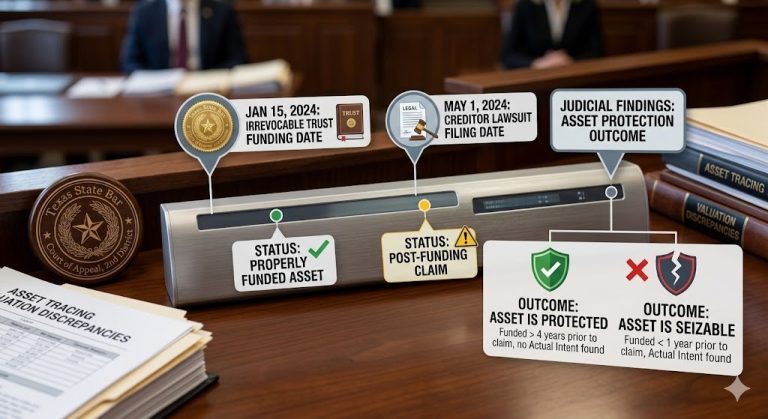
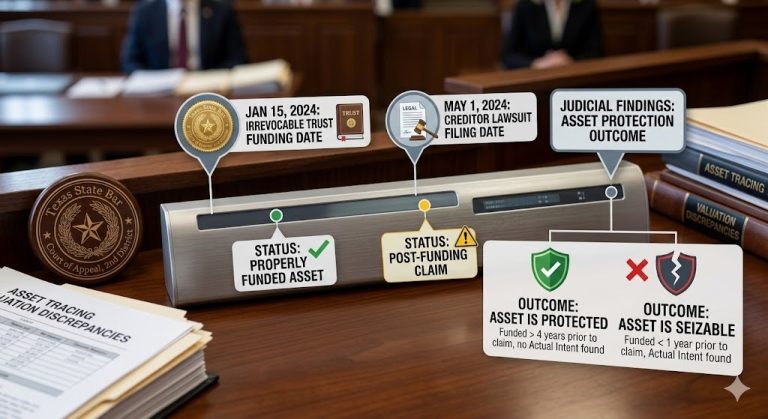
“Properly” should include decisions such as “do we just gift it?” or “do we create an exchange of fair value (legally known as consideration)?” The Fraudulent Transfer Act can throw a curveball if ever challenged in the first 4-5 years of a transfer. We wouldn’t want the judge to reverse the transfer due to a technicality and leave everything wide open for a creditor to put a lien on.
The Look-Back Period and Intent
Every state has a version of the Uniform Fraudulent Transfer Act (UFTA). This law allows courts to reverse asset transfers if they determine the transfer was made with the intent to hinder, delay, or defraud a creditor.
- Badges of Fraud: Courts look for specific warning signs, such as transferring assets to an insider (family member), retaining control of the asset after transfer, or becoming insolvent shortly after the transfer.
- The Lesson: You must set up your defenses when the seas are calm. If you wait until the storm hits, the court will tear down your shelter.
This implies you cannot call an asset protection company to hide money after being sued. Irrevocable trust asset protection is preventative medicine, not a cure for a disease you already have.
The Power of “Consideration”
One sophisticated way to navigate this is through “fair value exchange.” Instead of gifting an asset to a trust (which looks suspicious if you have debts), you can sell the asset to the trust in exchange for a Promissory Note.
- Why this works: You haven’t reduced your net worth; you’ve just changed the form of your net worth from a liquid asset (cash/property) to an illiquid asset (a note payable over 30 years).
- The Result: If a creditor sues you, they can seize the Promissory Note, but they cannot force the trust to pay it off early. They are stuck holding a piece of paper that pays them a small amount over decades, which gives you massive leverage to negotiate a settlement.
This strategy is utilized by a top-tier company to keep you compliant with UFTA while achieving asset protection. It turns a “fraudulent transfer” accusation into a legitimate transaction.
Advanced Strategies: Layering for Maximum Security
For those with significant assets or high-risk profiles, a simple trust may not be enough. You may need to “layer” your protection.
- The “LLC Inside a Trust” Strategy
You can place your rental properties into individual Limited Liability Companies (LLCs), and then have your Irrevocable Trust own the LLCs.
- The Benefit: This provides two layers of protection. The LLC protects your personal assets from lawsuits originating at the property (Inside-Out liability). The Trust protects the LLC from lawsuits originating against you personally (Outside-In liability).
This “belt and suspenders” approach is recommended by every experienced company. It ensures that a breach in one wall does not compromise the castle. It is the pinnacle of structuring.
- Equity Stripping
If you have a property with $1 million in equity, it is a target. You can reduce this target by stripping the equity.
- The Mechanism: You can take out a line of credit or record a mortgage against the property in favor of a friendly entity (like another trust).
- The Result: On public record, the property appears to have little to no equity. A plaintiff attorney doing an asset search will see a fully encumbered property and may decide it is not worth the cost to pursue litigation, as there is nothing to collect.
- Jurisdiction Shopping
You do not have to set up your trust in the state where you live. You can choose a jurisdiction with better laws.
- Nevada: Has a 2-year statute of limitations on future creditors.
- South Dakota: Has no rule against “perpetuities,” meaning your trust can last forever (a Dynasty Trust), avoiding estate taxes for generations.
An asset protection company acts as your guide through these jurisdictions, helping you select the state that offers the most robust statutes.
Conclusion: Wrapping It All Up
By now, it should be clear that setting up a trust isn’t just about moving money around; it’s about putting safeguards and incentives in place for the people and causes that matter most. From defining your goals and choosing the right trust type to selecting a trustee and properly funding the structure, every step builds toward lasting security.
Ultimately, the decision to engage in asset protection is a decision to take control of your financial destiny. It is an acknowledgement that the world is unpredictable. You need a fortress. And often, you need the guidance of a professional to build it.
Do not wait for the storm clouds to gather. The best time to implement protection was yesterday. Your legacy is defined by what you keep. By partnering with a reputable asset protection company, you ensure your life’s work benefits your family, not your creditors.
Working with a team like Estate Street Partners LLC ensures the process is handled with precision, insight, and strategies tested in the real world. At the end of the day, trusts aren’t just financial tools; they’re blueprints for peace of mind. Protecting what you’ve built doesn’t happen by accident, and the effort you put in today could be the reason your loved ones thrive tomorrow.
[sp_easyaccordion id=”35741″]
Frequently Asked Questions (FAQ)
References and Sources
Internal Revenue Service (IRS) https://www.irs.gov/businesses/small-businesses-self-employed/abusive-trust-tax-evasion-schemes-questions-and-answers
Uniform Law Commission https://www.uniformlaws.org/committees/community-home?CommunityKey=64ee1ccc-a3ae-4a5e-a18f-a5ba8206bf49
American Bar Association (ABA) https://www.americanbar.org/groups/real_property_trust_estate/
Cornell Law School Legal Information Institute – https://www.law.cornell.edu/wex/category/estate_planning
Estate Street Partners LLC – https://www.ultratrust.com/
Investopedia https://www.investopedia.com/terms/a/asset-protection-trust.asp
Helpful resources: Common follow-up reading includes Asset Protection Trust, Revocable vs Irrevocable Trust, and official IRS estate and gift tax guidance when weighing practical next steps.
What often changes the answer
After reviewing Irrevocable Trust Asset Protection Planning Through Professional Guidance, many people want a clearer sense of how the answer changes once real life timing, funding, and control are added to the discussion.
What usually shapes the next step
- Personal guarantees, leases, and vendor contracts can create exposure that an LLC alone does not erase.
- Ownership design matters because the best structure usually separates operating risk from long-term wealth.
- Funding matters because business owners need a plan that covers both current assets and future cash flow.
Where readers often continue
A practical next reading path is Asset Protection for Business Owners, LLC vs Trust for Asset Protection, and Asset Protection From Lawsuit. When the question turns from reading to implementation, many readers move from these guides to a direct planning conversation.